Read the novel after the movie
You already know the story, so the novel can give you what a movie has no room for: what the characters are thinking, the scenes that were cut, and the ending as it was written. If you loved the movie, read this next.
5 more books for people who loved Dances with Wolves
Dances with Wolves asks you to sit with silence, distance, and the slow burn of cross-cultural understanding. It refuses to hurry: scenes linger on landscape, on failed attempts at communication, on the mundane rituals that build trust. The film earns its emotional weight through patience, letting moral questions unfold without easy answers. These books share that commitment to immersion, to showing how people bridge seemingly unbridgeable divides, and to portraying cultures with specificity rather than sentiment.

Dances with Wolves
Dances with Wolves began here, and the novel gives even more room to Lieutenant Dunbar's daily routines at the outpost and his gradual absorption into Lakota life. Blake's prose is spare and deliberate, tracking the incremental shifts in language acquisition, trust, and belonging. The book lingers on small moments—shared meals, hunting trips, the physics of survival on the frontier—that the film necessarily compresses. It deepens the secondary characters and extends the moral consequences of Dunbar's transformation, letting readers inhabit the discomfort and exhilaration of straddling two worlds.
Read it with your book club →
Ceremony
Ceremony shares Dances with Wolves' attention to ritual, landscape, and the difficult work of cultural reconnection. Tayo, a Laguna Pueblo veteran, returns from World War II fractured and must relearn the ceremonies that anchor his community. Silko moves between prose and poetry, between present trauma and mythic time, showing how healing is inseparable from place and tradition. The novel resists simplification: Tayo's journey is neither redemptive arc nor tragedy but a careful, painful reintegration. Like the film, it asks readers to respect complexity and to understand culture as lived practice, not symbol.
Read it with your book club →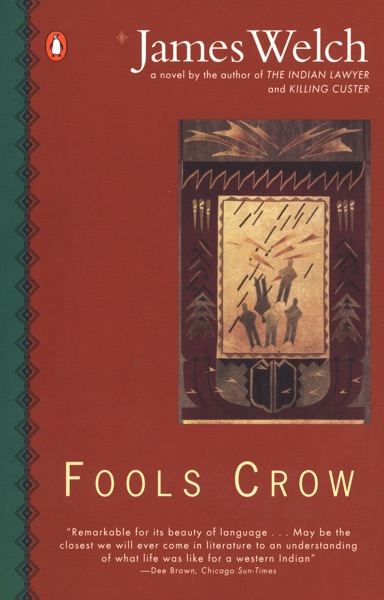
Fools Crow
Fools Crow offers what Dances with Wolves gestures toward: a story told entirely from within a Native community, without a white intermediary. Set among the Blackfeet in Montana in the 1870s, the novel follows a young warrior as he comes of age while encroaching settlers and disease threaten his people. Welch renders daily life—hunts, ceremonies, courtship, councils—with specificity and dignity, never pausing to explain for outsiders. The pacing is patient, the moral stakes cumulative. Like the film, it treats cultural difference as something to be inhabited, not simplified, and it refuses to look away from violence or loss.
Read it with your book club →
Blood Meridian
Blood Meridian inverts the moral arc of Dances with Wolves but shares its unflinching commitment to the violence and desolation of the frontier. McCarthy's novel follows a teenage runaway through the Southwest in the 1850s as he joins a gang of scalp hunters. The prose is biblical and relentless, the landscape vast and indifferent, the violence explicit and unmitigated by sentiment. Where the film finds connection across cultures, McCarthy finds savagery as a constant. Both works resist the romanticized Western, insisting instead on the historical weight of conquest, displacement, and brutality. Neither offers easy comfort.
Read it with your book club →
Winter in the Blood
Winter in the Blood offers the landscape and emotional reserve of Dances with Wolves transposed to the twentieth-century Northern Plains. An unnamed Blackfeet narrator drifts through Montana in the 1960s, estranged from his family and himself, searching for meaning in a world where tradition and modernity sit uneasily together. Welch writes with economy and precision, letting silence and space carry weight. The novel resists melodrama: grief, loneliness, and small acts of connection accumulate quietly. Like the film, it treats the land as character and witness, and it refuses to impose narrative closure on questions that remain open.
Read it with your book club →Want books picked for you?
One movie isn’t much to go on. Rate four more — Dances with Wolves already counts — and the books are picked for you.
Rate four more movies