Co-written with Quincy Troupe.
Read it with your book club →Read the memoir after the movie
You already know the story, so the memoir can give you what a movie has no room for: what the characters are thinking, the scenes that were cut, and the ending as it was written. If you loved the movie, read this next.
6 more books for people who loved The Pursuit of Happyness
The film strips away melodrama to show survival as a sequence of daily humiliations and small tactical wins. It refuses to sentimentalize homelessness or poverty, holding instead to the grinding arithmetic of what it costs to stay functional when the system is designed to eject you. The warmth between father and son never softens the economic terror. These books follow people who refuse to collapse under structural pressure, who calculate their next move while the floor drops away beneath them.
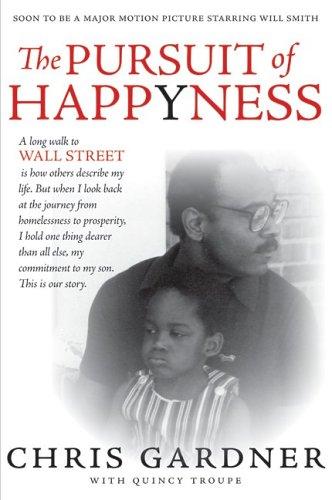
The Pursuit of Happyness
The Pursuit of Happyness emerged from this memoir, which tracks Gardner's year of homelessness while competing for an unpaid stockbroker internship with his toddler son in tow. The book lays out the arithmetic of survival with more detail than the film allows: the cost of daycare versus lost work hours, the shelter lottery system, the exact sum needed to keep a car from being towed. Gardner writes in clean, unsentimental prose about the cognitive load of appearing employable while sleeping in subway bathrooms. The bond with his son is fierce but never romanticized as compensation for deprivation.
Read it with your book club →
Evicted: Poverty and Profit in the American City
The Pursuit of Happyness shows how housing instability devours every other effort at stability, and Desmond's book makes that mechanism visible across eight Milwaukee families facing eviction. He follows tenants and landlords through the monthly crisis of rent, documenting how a single missed payment starts a cascade that costs jobs, schooling, and health. The prose is patient and exact, tracking the small decisions that look like bad choices until you see the impossible menu of options. Desmond never abstracts poverty into statistics; these are people making tactical bets with no margin for error.
Read it with your book club →
Nickel and Dimed: On (Not) Getting By in America
The Pursuit of Happyness turns on the same brutal math that Ehrenreich documents: how low-wage work costs more in transportation, childcare, and health than it pays. She takes jobs as a waitress, hotel maid, and Walmart clerk, calculating the gap between wages and the minimum cost of shelter. The tone is wry but never detached; she records the physical toll and the managerial cruelty without condescension toward her coworkers. The book makes visible the cognitive work of staying employed when you cannot afford to be employed. It shares the film's refusal to make poverty picturesque.
Read it with your book club →
Random Family: Love, Drugs, Trouble, and Coming of Age in the Bronx
The Pursuit of Happyness depends on the fierce intimacy between father and son under pressure, and LeBlanc's book follows two families through a decade of incarceration, poverty, and survival in the South Bronx with the same relational intensity. She embeds herself so deeply that the prose carries no anthropological distance; these are people navigating impossible systems with intelligence and love. The book tracks how structural forces shape daily choices without stripping anyone of agency. LeBlanc writes with the same patient attention to dignity under duress that the film holds for Gardner and his son.
Read it with your book club →
A Place to Stand
The Pursuit of Happyness shows a man rebuilding himself while institutions try to erase him, and Baca's memoir follows the same arc through the wreckage of illiteracy, addiction, and prison. He teaches himself to read in a maximum-security cell and begins writing poetry as a form of cognitive survival. The prose is raw and direct, tracking the incremental work of becoming legible to the world when the world has written you off. Baca never asks for pity; he documents transformation as a series of small refusals to disappear. The book shares the film's faith in agency against structural brutality.
Read it with your book club →
The Short and Tragic Life of Robert Peace
The Pursuit of Happyness bets everything on the belief that individual effort can overcome structural disadvantage, and Hobbs's biography complicates that wager by following a Yale graduate who cannot escape the economics of his Newark neighborhood. Peace is brilliant, disciplined, and loved, but the financial pressure of supporting his family while navigating two incompatible worlds becomes unsustainable. Hobbs writes with deep respect for his subject, refusing to simplify the forces that kill him. The book asks the same questions as the film about what survival costs and who gets to pay in effort rather than in life.
Read it with your book club →Want books picked for you?
One movie isn’t much to go on. Rate four more — The Pursuit of Happyness already counts — and the books are picked for you.
Rate four more moviesAll 6 books like The Pursuit of Happyness, with the picker →